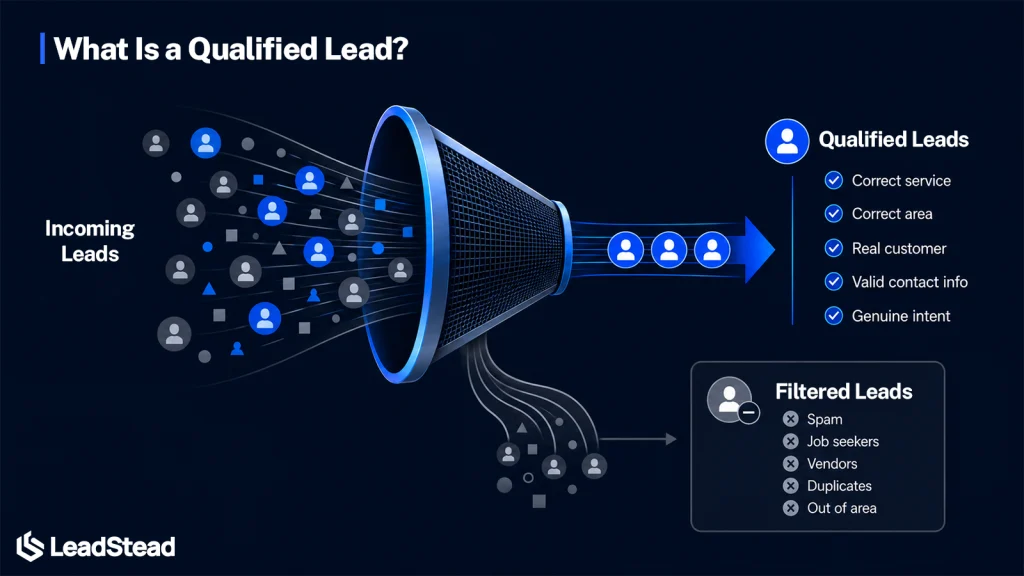

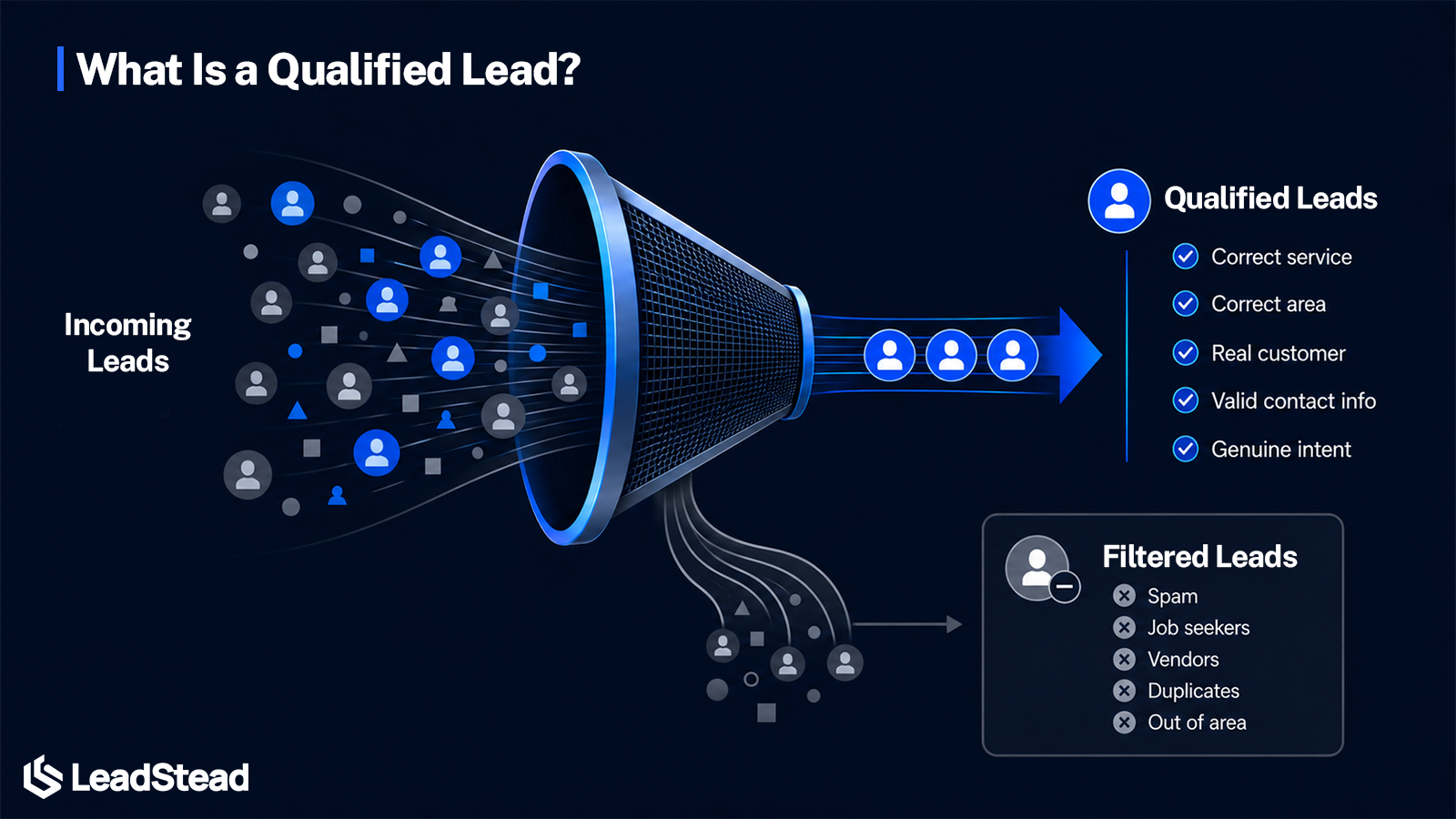
A qualified lead is an inquiry from a real prospective customer who matches the basic criteria a business has established for the services it wants to sell.
For a service business, that usually means the person is looking for a service you actually provide, is located within an area you serve, has provided usable contact information and appears to have a genuine intention of hiring a company.
That distinction matters.
A form submission is not automatically a qualified lead. A phone call is not automatically a qualified lead either.
If someone contacts an HVAC company looking for a job, submits a fake phone number, needs service 200 miles outside the company’s service area or is trying to sell the company something, technically an inquiry took place. But it would make very little sense to treat any of those as a legitimate sales opportunity.
At LeadStead, we believe lead generation should ultimately be measured around qualified opportunities, not simply the number of forms, calls or conversions reported by an advertising platform.
What Makes a Lead Qualified?
There is no universal definition that works for every company.
A qualified lead for an HVAC contractor may look completely different from a qualified lead for a commercial cleaning company.
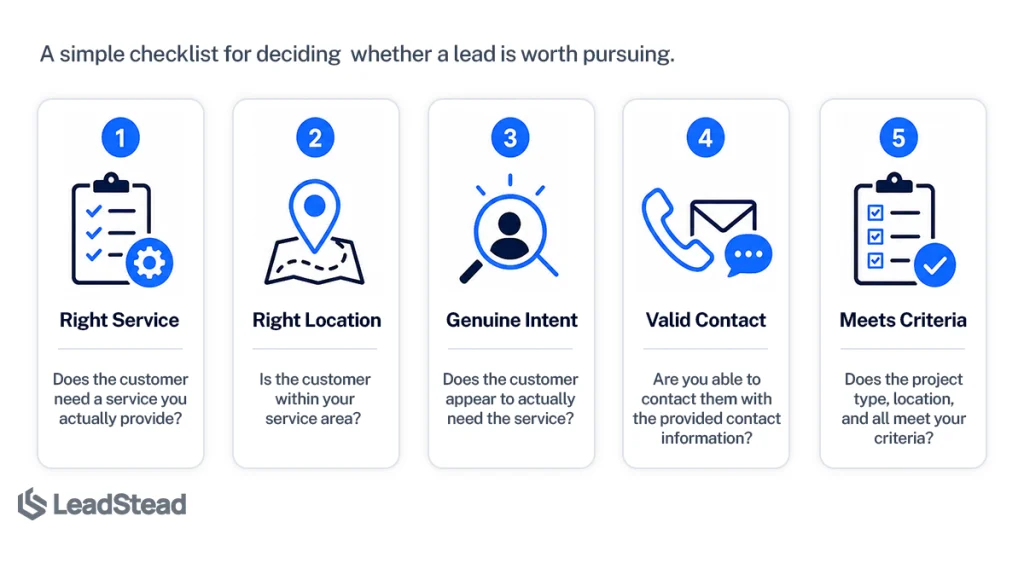
However, most service businesses can evaluate lead quality using a few basic criteria. Some of the criteria are:
1. The Prospect Is Looking for a Service You Provide
The first question is simple:
Can your business actually help this person?
If a roofing company generates an inquiry from someone looking for roof replacement, repair or another service the contractor offers, there may be a legitimate opportunity.
If that same company receives an inquiry about gutter cleaning but does not provide gutter cleaning, the lead may not be useful.
This is why qualification criteria should be established around the actual services a business wants to generate.
The same principle applies across industries.
An HVAC lead generation campaign might target air conditioner repairs, furnace replacements, heat pumps or maintenance.
A plumbing lead generation campaign might focus on emergency plumbing, drain services, water heaters or larger plumbing projects.
A roofing lead generation campaign could be designed primarily around roof replacements rather than low-value repair inquiries.
The definition of a qualified lead should reflect what the business is actually trying to sell.
2. The Customer Is Within Your Service Area
Location is one of the simplest qualification criteria for local service businesses.
A contractor serving the Los Angeles Area does not benefit much from an otherwise excellent lead located in Phoenix.
Likewise, a roofing contractor operating within a 50-mile radius may not consider a customer 120 miles away to be a realistic opportunity.
For this reason, service territory should normally be established before a campaign begins.
That can include:
- Specific cities
- ZIP or postal codes
- Counties or regions
- A defined radius
- Individual territories where different services are available
Geographic qualification becomes particularly important when advertising costs are involved. There is little value in paying to generate inquiries that the company cannot realistically service.
3. The Prospect Has Genuine Buying Intent
This is where lead quality becomes more complicated.
A real person submitting a real form does not necessarily mean there is a genuine sales opportunity.
Consider the difference between these two inquiries.
One homeowner says:
“My furnace stopped working this morning. I’m looking for someone who can come out today.”
Another says:
“I’m thinking about replacing my furnace sometime within the next few years and was just curious what one might cost.”
Both inquiries may technically be leads.
But they clearly have different levels of intent.
Qualification does not always require someone to be ready to buy immediately. Longer sales cycles are normal for many services. Commercial cleaning contracts, large roofing projects and major landscaping projects may involve research, multiple estimates and internal approvals.
The important question is whether the prospect appears to have a legitimate need that the business can potentially solve.
4. The Contact Information Is Usable
A lead has very little value if your team has no realistic way to contact the person.
Depending on the campaign, valid contact information may include:
- A working telephone number
- A legitimate email address
- A name
- A business name for commercial inquiries
- A service address or ZIP/postal code
Nobody should expect every prospect to answer the first phone call.
That is different from receiving obviously false or unusable information.
A prospect who does not answer immediately can still be a perfectly legitimate lead. A form submitted with a fake telephone number and nonexistent email address generally is not.
This is also why lead nurturing and follow-up matter. Qualification determines whether there appears to be a genuine opportunity. Follow-up determines whether the business can turn that opportunity into a conversation.
5. The Lead Meets Any Additional Criteria Established by the Business
Some companies need more specific qualification rules.
For example, a contractor may only want:
- Residential projects
- Commercial projects
- Projects above a certain size
- Property owners rather than tenants
- Specific service categories
- Certain equipment types
- Certain property types
A commercial cleaning company may only want offices above a particular square footage.
A paving contractor may be looking primarily for commercial parking lots.
A landscaping company may want design/build projects rather than basic lawn cutting.
There is nothing wrong with having narrow qualification requirements if they make sense for the business.
The important part is defining those requirements before judging campaign performance, rather than changing the definition whenever a lead arrives that the sales team does not like.
What Usually Does Not Count as a Qualified Lead?
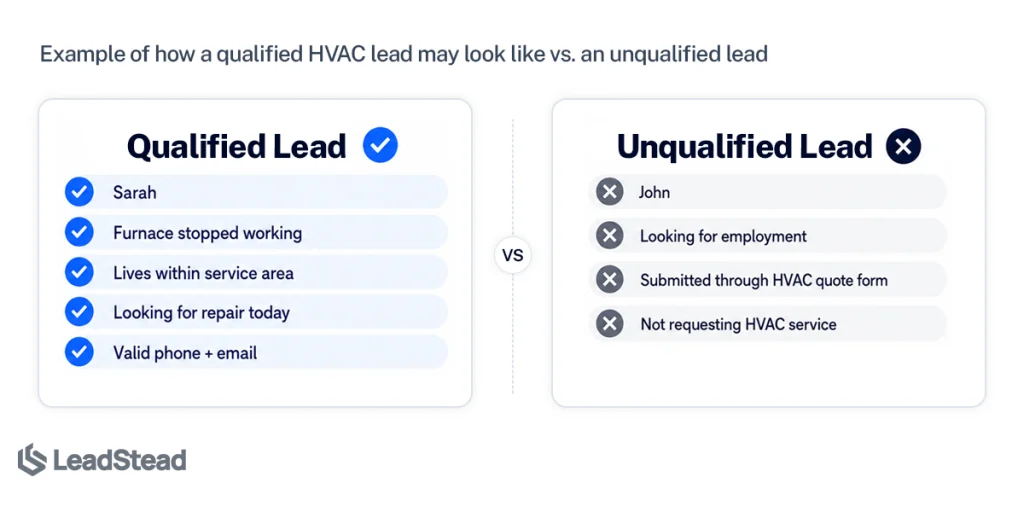
While exact rules vary by campaign, there are several types of inquiries that would commonly be excluded from qualified lead reporting.
Spam and Bot Submissions
Automated form spam, obviously fraudulent inquiries and other non-human submissions should not be treated as legitimate leads.
Job Seekers
Employment inquiries are one of the most common sources of unwanted form submissions for service companies.
Someone asking whether your HVAC company is hiring may be a real person, but that does not make them a customer lead.
Vendors and Sales Solicitation
Marketing agencies, software companies, equipment suppliers and other businesses regularly use website forms to contact companies.
Again, these are real inquiries.
They simply aren’t prospective customers.
Requests Outside the Service Area
If the customer is located outside the territory established for the campaign, the inquiry would generally not qualify.
Requests for Services You Do Not Offer
The person may have genuine buying intent, but if they are looking for something the company does not provide, there may be no viable sales opportunity.
Duplicate Leads
If the same person submits a form several times within a short period, it usually does not make sense to report each submission as a completely new opportunity.
Businesses should establish a reasonable duplicate window based on their sales cycle and service.
Invalid Contact Information
Completely unusable or fraudulent contact information may make it impossible for the business to pursue the opportunity.
A Qualified Lead Is Not the Same as a Guaranteed Customer
This is one of the most important distinctions in lead generation.
Qualified does not mean closed.
A legitimate homeowner who needs a new roof, lives within your territory and asks for an estimate can be an excellent qualified lead.
They can still hire another contractor.
They can decide the project is too expensive.
They can postpone the project.
They can stop answering their phone.
They can collect five estimates and choose someone else.
None of those outcomes necessarily mean the original lead was bad.
Marketing is responsible for creating opportunities. Sales and operations still play a significant role in turning those opportunities into customers.
This is why we generally look at the entire path:
Traffic → Inquiry → Qualified Lead → Contact → Appointment → Estimate → Customer
The further a business can track that journey, the more useful its marketing data becomes.
Our CRM and conversion tracking approach is built around making that connection clearer wherever the business’s systems allow it.
Qualified Lead vs Raw Lead
A raw lead is essentially an inquiry.
Someone filled out a form.
Someone called a tracking number.
Someone submitted a Facebook lead form.
An advertising platform may count that action as a conversion.
A qualified lead goes one step further.
The inquiry has been evaluated against the criteria that actually matter to the business.
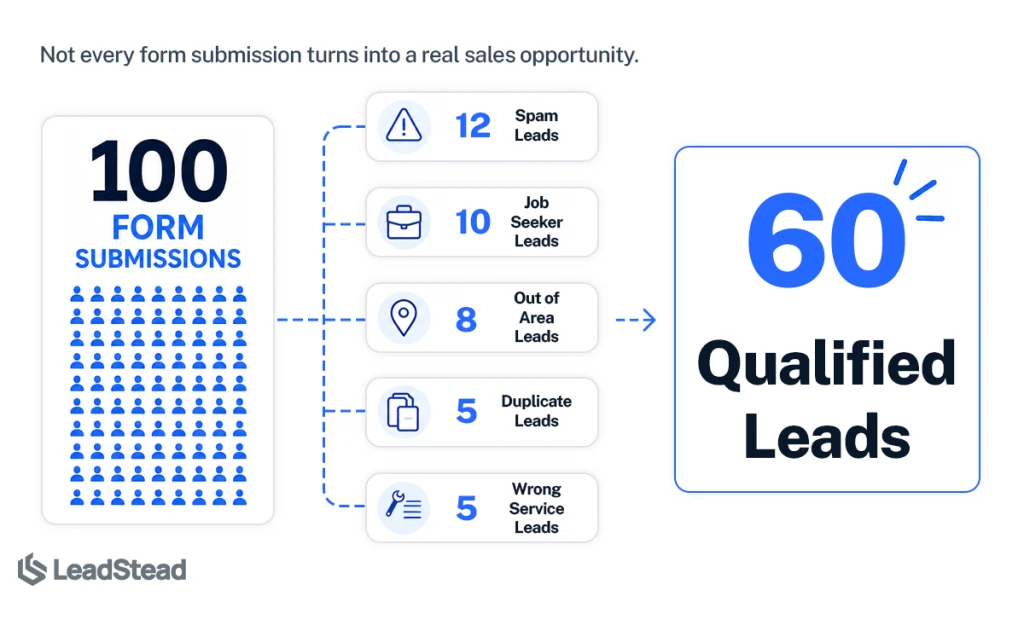
Consider a campaign that generates 100 form submissions.
At first glance, the results might look excellent.
But after reviewing those inquiries, imagine that:
- 12 were spam
- 8 were job seekers
- 10 were outside the service area
- 5 were duplicate submissions
- 5 requested services the contractor does not provide
The campaign didn’t really generate 100 usable sales opportunities.
It generated 60 qualified leads.
That is the number we would care much more about.
We’ll cover this distinction more deeply in our guide to Qualified Leads vs Raw Leads, because it becomes especially important when evaluating advertising performance.
Why Qualified Leads Matter More Than Lead Volume
Businesses don’t make money from form submissions.
They make money from customers.
This seems obvious, but marketing reports frequently lose sight of it.
Imagine these two campaigns:
| Campaign A | Campaign B | |
|---|---|---|
| Inquiries | 100 | 60 |
| Ad Spend | $5,000 | $5,000 |
| Cost Per Lead | $50 | $83 |
| Qualified Opportunities | 30 | 45 |
| Cost Per Qualified Lead | $167 | $111 |
If we only looked at raw cost per lead, Campaign A would appear to be the clear winner.
But Campaign B actually generated 50% more qualified opportunities with the same advertising budget.
Campaign A’s qualified lead cost is approximately $167.
Campaign B’s qualified lead cost is approximately $111.
Suddenly the conclusion changes completely.
This is one of the reasons cost per lead can be a misleading marketing metric when it is viewed without any context around lead quality.
The cheapest leads are not necessarily the best leads.
And the campaign generating the most leads is not necessarily generating the most business.
How Should a Business Define a Qualified Lead?
Before spending significant money on lead generation, a business should be able to answer a few questions.
What services are we trying to sell?
Where do we provide those services?
Who is a legitimate prospective customer?
What should automatically disqualify an inquiry?
How should duplicates be handled?
Are there minimum project requirements?
Are there specific types of jobs we don’t want?
The criteria should be specific enough to provide meaningful measurement without becoming so restrictive that every lost sale gets classified as a bad lead.
That last part is important.
A salesperson not closing a prospect does not automatically disqualify the lead.
If businesses redefine every lost opportunity as “unqualified,” it becomes impossible to determine whether the actual problem is marketing, sales, pricing, response time, reputation or something else.
Good qualification criteria create accountability on both sides.
How LeadStead Approaches Lead Qualification
LeadStead works with many types of businesses, where the definition of a valuable opportunity can vary significantly by industry.
Before evaluating campaign performance, we want the basic qualification rules to be clear.
Depending on the engagement, that can include:
- Approved services
- Geographic territory
- Customer type
- Valid contact requirements
- Duplicate rules
- Known exclusions
- Other campaign-specific requirements
For example, the qualification criteria for an HVAC company looking for replacement opportunities should not necessarily be identical to those of a restoration company trying to generate emergency water-damage calls.
Likewise, a commercial cleaning company pursuing recurring contracts should not be evaluated exactly like a residential plumbing company handling same-day service calls.
The economics and buying process are different.
That is why our fully managed lead generation campaigns are built around the business first rather than forcing every client into exactly the same acquisition model.
What About Pay-Per-Lead Programs?
Qualification becomes even more important when a company is paying directly for individual leads.
If a provider charges for every name and phone number regardless of quality, the advertised price per lead does not tell you very much.
A $40 lead that has only a 20% chance of meeting your basic qualification criteria may ultimately be more expensive than a $100 lead that consistently matches the work you want.
Businesses evaluating pay per lead programs should therefore understand exactly what they are paying for.
Questions worth asking include:
- What qualifies as a billable lead?
- Are leads exclusive or shared?
- What happens with spam?
- What happens with duplicate leads?
- Are out-of-area inquiries credited?
- Are leads screened for the requested service?
- Can the qualification rules be documented in advance?
The definition of the product matters just as much as the advertised price.
Qualification Is Only the Beginning
Generating a qualified lead creates an opportunity.
What happens next can be just as important as how the lead was generated.
A strong prospect can quickly become a lost opportunity when:
- Calls go unanswered
- Form submissions sit untouched for hours
- Nobody follows up after the first attempt
- Estimates are sent without follow-up
- Lead information never reaches the right salesperson
- The business does not track what happened
This is why LeadStead looks beyond the initial advertising conversion.
Paid advertising, landing pages, qualification, tracking and follow-up should work as parts of the same system.
The objective is not simply to produce more leads.
It is to create more opportunities that have a realistic chance of becoming revenue.
Frequently Asked Questions About Qualified Leads
A qualified lead is a prospective customer who meets the basic criteria established by a business, such as requesting an approved service, being located within the service area, providing usable contact information and demonstrating genuine interest.
No.
Some services have much longer buying cycles than others. A qualified prospect may still need an estimate, consultation, internal approval or time to compare providers.
Qualification means there is a legitimate potential opportunity. It does not guarantee an immediate sale.
No.
Calls can come from job seekers, vendors, existing customers, wrong numbers, spam and people requesting services the company does not offer.
The call should still be evaluated against the business’s qualification criteria.
No.
A form submission is an inquiry or conversion event. It becomes a qualified lead when it meets the criteria established by the business.
A lead generally refers to someone who has expressed interest or submitted an inquiry.
A qualified lead has been reviewed and determined to match the business’s basic customer, service, territory and contact requirements.
Absolutely.
Pricing, competition, response time, availability, reputation, sales ability and many other factors influence whether a qualified opportunity ultimately becomes a customer.
The Bottom Line
A qualified lead is not simply someone who filled out a form or called a phone number.
It is a real prospective customer who has a legitimate need for a service your business provides and meets the qualification criteria established for the campaign.
That distinction gives businesses a much clearer way to evaluate marketing.
Instead of asking:
“How many leads did we get?”
A better sequence of questions is:
- How many inquiries did we generate?
- How many were qualified?
- How many did we contact?
- How many became appointments or estimates?
- How many became customers?
- How much revenue did those customers generate?
That is when lead generation starts becoming measurable as a business process rather than simply an advertising report.
LeadStead helps businesses build lead generation systems around that complete journey, from attracting the right prospects through paid advertising and SEO to landing pages, qualification, tracking and follow-up.
If your company wants to generate more qualified opportunities instead of simply increasing raw lead volume, explore our fully managed lead generation and pay per lead options to see which approach better fits your business.